Quick answer: Open terrariums are best for succulents, cacti and plants that prefer dry conditions, while closed terrariums create a humid, self-regulating ecosystem ideal for tropical plants, mosses and ferns. The best choice depends on maintenance requirements, humidity levels and the intended commercial application.
Terrariums have evolved from decorative niche concepts into fully integrated green solutions within commercial interiors. In offices, hospitality venues, retail environments and waiting areas, terrariums provide a compact, low-maintenance and visually distinctive planting option.
In professional applications, however, a key question often arises: should you choose an open or a closed terrarium?
While both systems may appear similar at first glance, they differ fundamentally in moisture regulation, maintenance structure and long-term performance. For project-based interior landscaping, understanding these differences is essential before making a strategic decision.
What Is an Open Terrarium?
An open terrarium is a glass or transparent container without a sealed top. Air circulates freely, allowing the system to function as a miniature garden within a controlled yet open environment.
Open terrariums are commonly used with succulents, cacti or tropical plants that do not require extremely high humidity. Due to their open structure, evaporation is higher and watering must be adjusted according to the surrounding climate.
In commercial interiors, open terrariums are often used as tabletop features, reception desk elements or as part of modular green installations.
What Is a Closed Terrarium?
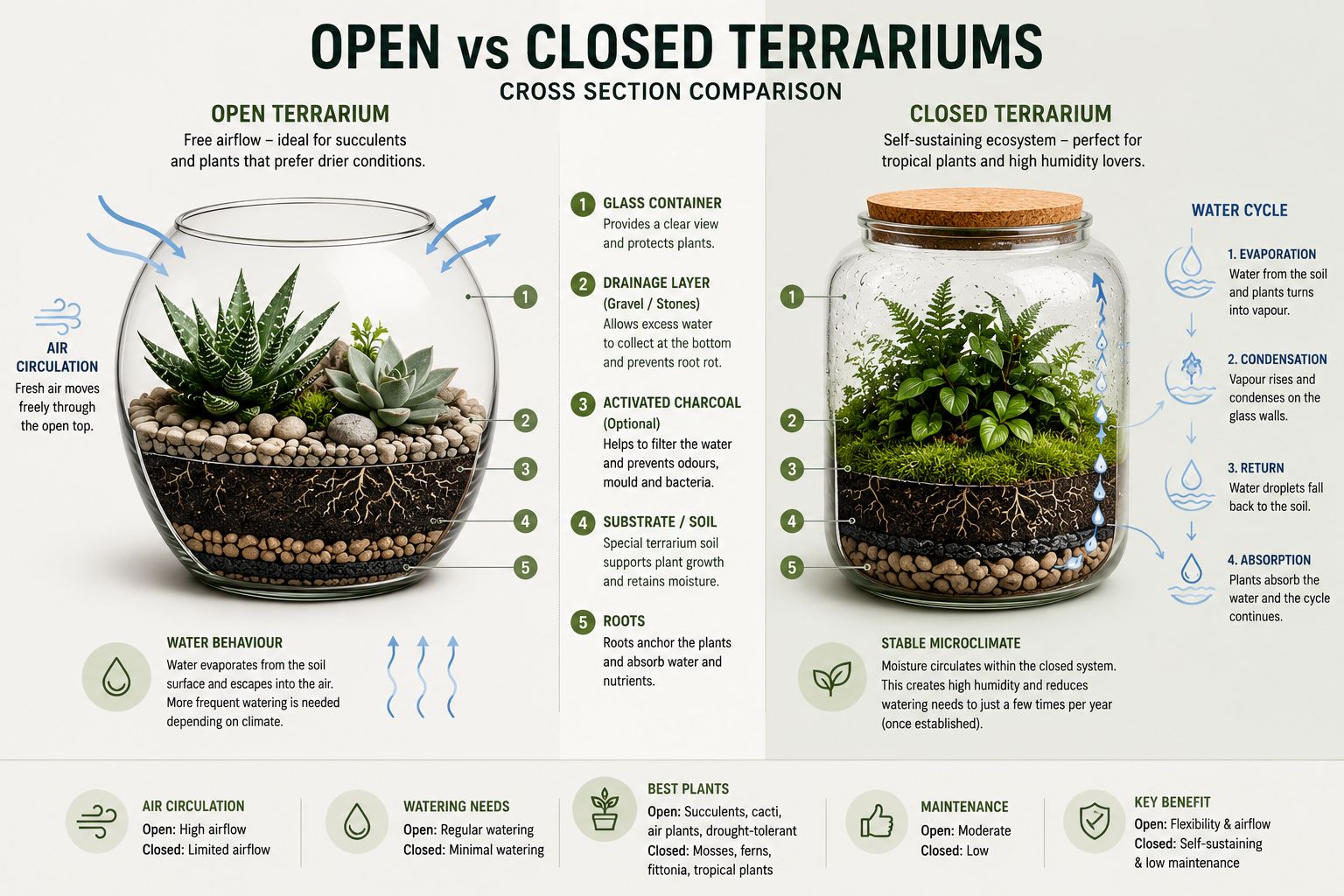
A closed terrarium functions as a self-contained mini ecosystem. The glass enclosure is largely sealed, allowing moisture to circulate within the system. Water evaporates, condenses on the glass and returns to the soil layer.
This creates a self-regulating humidity balance, significantly reducing watering frequency. Closed terrariums are particularly suitable for plants that thrive in high humidity, such as mosses, ferns and compact tropical species.
In professional environments, closed terrariums are frequently used as visual statement pieces or sustainable, low-maintenance design elements.
Moisture Regulation: The Key Operational Difference
The primary distinction between open and closed terrariums lies in water management.
In an open terrarium, moisture continuously evaporates into the surrounding air. As a result, humidity levels, temperature and ventilation directly influence watering needs. In climate-controlled office environments with dry air, plants may dry out more quickly.
A closed terrarium, in contrast, retains moisture within the system. This creates a stable microclimate that is less sensitive to external fluctuations. In locations with limited maintenance frequency, this stability can be a significant advantage.
For international projects where daily plant care is not feasible, closed systems often provide greater predictability.
Maintenance in Commercial Projects
Maintenance structure is critical in B2B environments.
Open terrariums require regular monitoring. Excess water may accumulate in the soil layer, while insufficient watering quickly becomes visible through plant stress. Because air circulates freely, dust can accumulate more easily on leaves and glass surfaces.
Closed terrariums require less frequent watering but demand precise initial installation. An imbalance in drainage or substrate composition can result in internal mould growth. Once properly established, however, the ecosystem typically remains stable over time.
For buildings with limited maintenance budgets, a well-designed closed terrarium can offer operational efficiency.
Risk of Mould and Pests
Hygiene plays an important role in commercial interiors.
Open terrariums benefit from ventilation, reducing internal mould risk. However, they may be more susceptible to external pests such as fungus gnats if organic soil is used.
Closed terrariums limit external contamination due to their sealed structure. At the same time, excessive internal moisture may create mould if drainage layers are incorrectly built.
Professional installation, including proper drainage, activated charcoal and substrate layering, is essential to minimise risk.
Plant Selection and Biodiversity
Open terrariums are suitable for species that tolerate drier conditions. Succulents and plants requiring moderate humidity often perform well in these systems.
Closed terrariums support tropical species that thrive in consistently humid environments. Mosses, miniature ferns and compact tropical foliage plants benefit from the stable microclimate.
In large-scale projects, uniformity is important. The choice between open and closed systems directly influences plant selection and maintenance structure.
Aesthetic Experience in Hospitality and Retail
Terrariums are not only functional but also design-driven elements within commercial spaces.
Open terrariums create a light, airy aesthetic with unobstructed plant visibility. They complement minimalist and contemporary interiors.
Closed terrariums generate a more immersive, ecosystem-like appearance. Light condensation on the glass can enhance the natural effect and contribute to experiential design.
In hospitality settings where atmosphere is central, closed terrariums can strengthen storytelling and spatial identity.
Scalability in Project Planting
Scalability is an important consideration in international B2B projects.
Open terrariums are generally easier to replicate in larger volumes. Their installation is less sensitive to microclimate balance, allowing efficient scaling.
Closed terrariums require more precision in assembly. At higher volumes, consistent layering and preparation are crucial to ensure uniform performance.
When projects span multiple locations, the choice between open and closed systems must align with maintenance structure and logistical capacity.
When to Choose an Open Terrarium
An open terrarium is suitable when:
-
Regular maintenance is available
-
The indoor climate is stable
-
A minimalist aesthetic is preferred
-
Faster scalability is required
-
Selected plants do not require high humidity
The system offers flexibility and visual openness.
When to Choose a Closed Terrarium
A closed terrarium is ideal when:
-
Maintenance frequency is limited
-
A stable microclimate is required
-
Tropical species are used
-
A premium ecosystem aesthetic is desired
-
International projects require predictable performance
The system provides self-regulating humidity and long-term stability.
Strategic Decision-Making in Professional Interior Planting
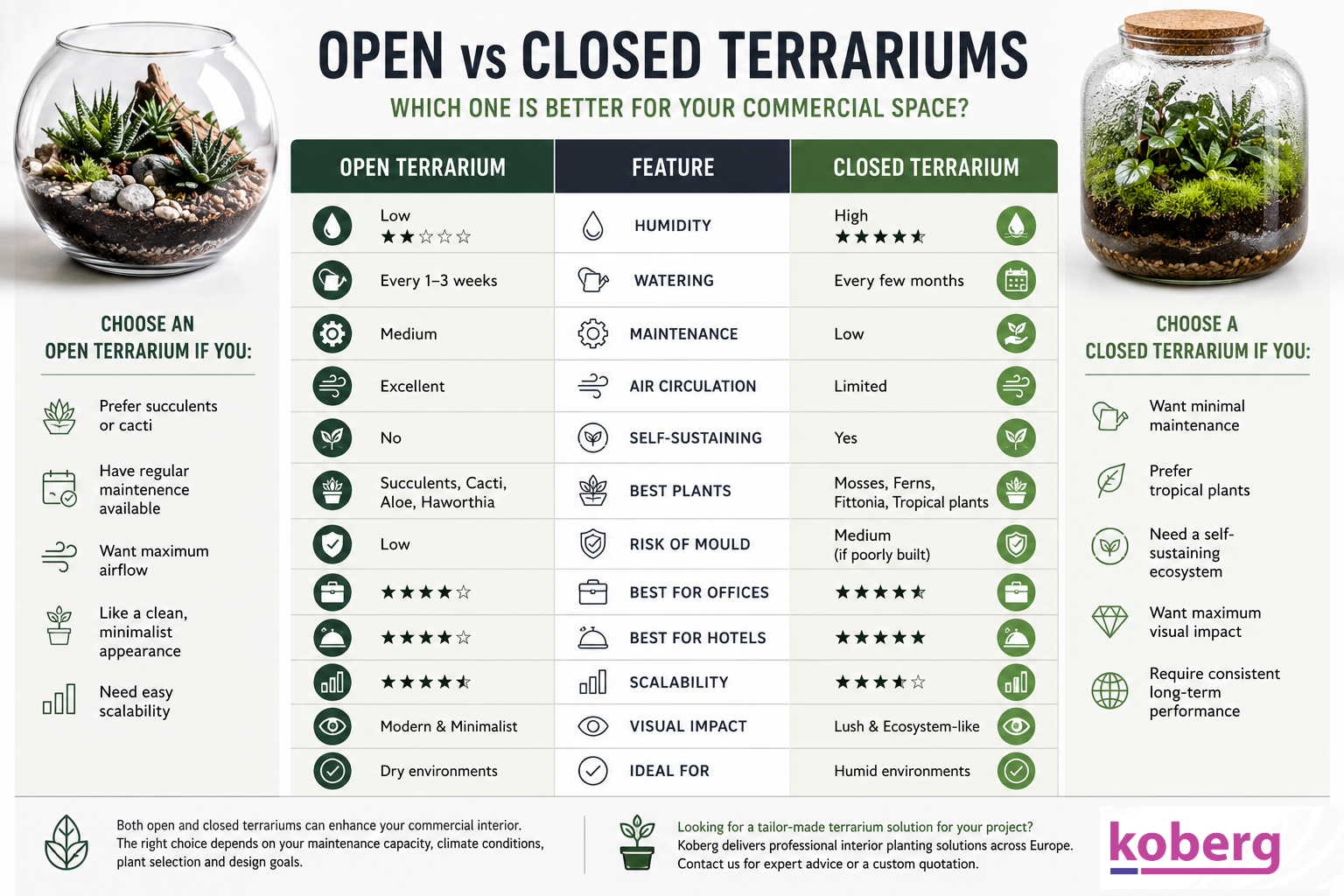
The choice between open and closed terrariums is not purely aesthetic. It is a strategic balance between maintenance capacity, climate conditions, scalability and visual goals.
In commercial interiors where continuity and reliability are priorities, closed terrariums often provide greater operational stability. In dynamic environments requiring flexibility and rapid implementation, open systems may be more suitable.
When design, maintenance and logistics are aligned, both systems can perform successfully within professional project planting.
Looking for a professionally designed terrarium for your office, hotel or commercial project? Koberg supplies complete interior planting solutions across Europe, including bespoke terrariums, planters and plant concepts tailored to professional environments. Contact our team for advice or request a quotation.
Frequently Asked Questions
What is an open terrarium?
An open terrarium is an unsealed glass container designed for plants that prefer lower humidity, such as succulents and cacti. Fresh air circulates freely, making it ideal for dry environments.
What is a closed terrarium?
A closed terrarium is a mostly sealed glass ecosystem where moisture continuously recycles. It creates a humid environment that supports tropical plants with minimal watering.
Which terrarium requires less maintenance?
Closed terrariums generally require less watering because moisture is recycled within the container. Open terrariums need more frequent monitoring and watering.
Can succulents grow in a closed terrarium?
No. Succulents typically require dry conditions and good airflow. A closed terrarium usually creates too much humidity, increasing the risk of rot.
Which plants belong in an open terrarium?
Popular choices include succulents, cacti, Haworthia, Aloe, Echeveria and Crassula.
Which plants belong in a closed terrarium?
Closed terrariums are ideal for mosses, Fittonia, miniature ferns, Peperomia and other humidity-loving tropical plants.
How often should I water a terrarium?
Open terrariums often need watering every one to three weeks, depending on the indoor climate. Closed terrariums may only need water a few times per year when properly established.
Why is my terrarium growing mould?
Mould is usually caused by excessive moisture, poor drainage or insufficient airflow. Using activated charcoal and a proper drainage layer helps prevent this.
How long does a terrarium last?
A well-built terrarium can last for many years. Closed terrariums can remain healthy for decades with only minimal maintenance.
Which terrarium is best for offices?
For most office environments, closed terrariums are preferred because they require less maintenance and maintain a stable microclimate.
Which terrarium is best for hotels?
Hotels often benefit from closed terrariums due to their premium appearance and low maintenance needs. Open terrariums are also suitable where regular plant care is available.
Are terrariums sustainable?
Yes. Terrariums reduce water consumption, extend plant longevity and require minimal resources, making them a sustainable choice for commercial interiors.
Can terrariums improve indoor wellbeing?
Terrariums contribute to biophilic design by introducing natural elements into indoor spaces, which can improve the overall atmosphere and visitor experience.
Are terrariums suitable for commercial interiors?
Yes. Terrariums are increasingly used in offices, hotels, restaurants, healthcare facilities and retail environments because they combine aesthetics with relatively low maintenance.
Where can I buy commercial terrariums?
Professional terrariums for offices, hospitality and commercial interiors can be sourced through specialist interior landscaping suppliers such as Koberg, who provide bespoke solutions tailored to each project.