Best Plants for Terrariums: A Professional Guide to Open and Closed Terrarium Plants
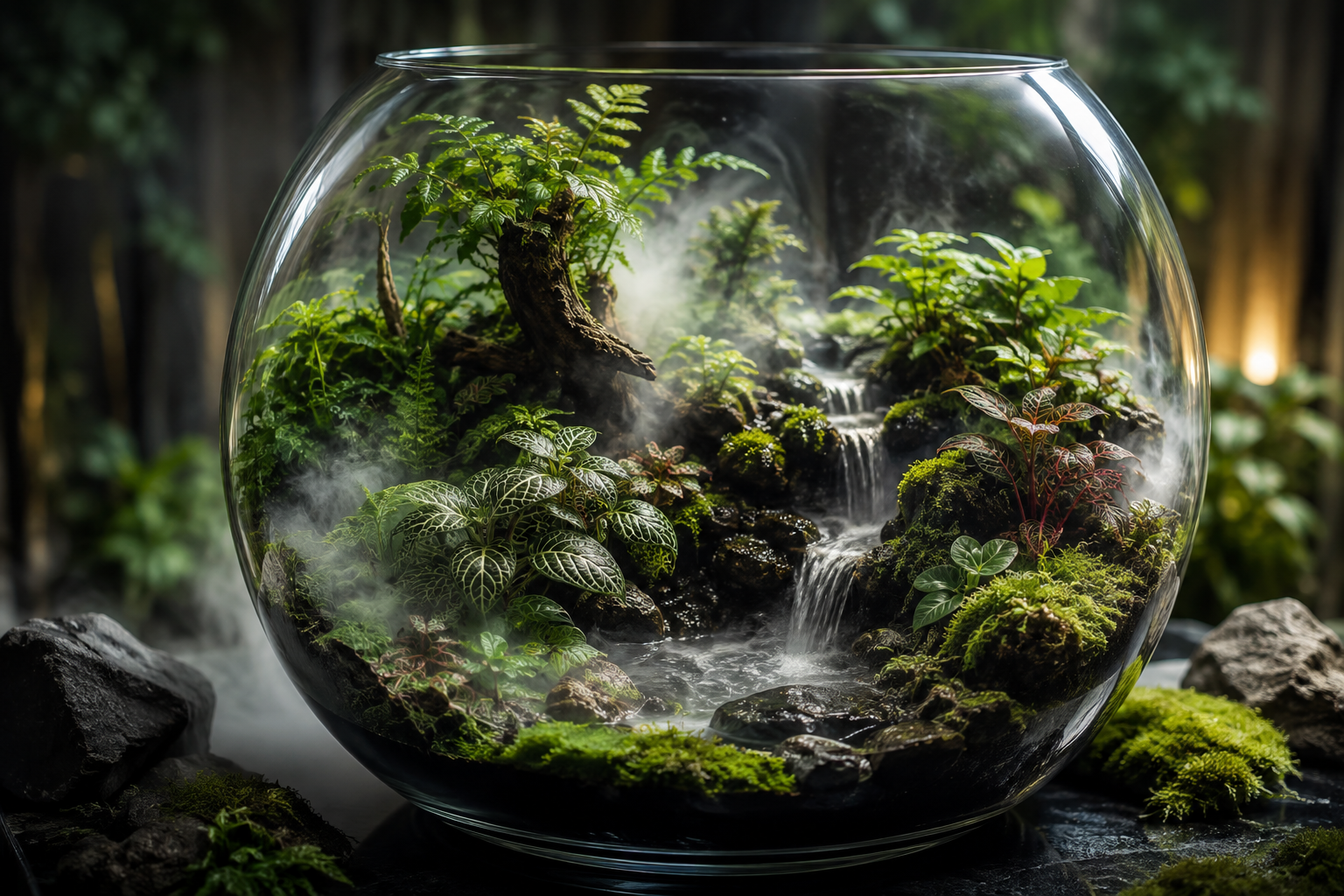
Terrariums look simple: a glass container, some substrate, a few plants and perhaps a layer of moss. But anyone who has worked with terrariums for a while knows that choosing the best plants for terrariums is where success or failure often begins.
Some plants thrive for years in the humid, protected environment of a closed terrarium. Others quickly develop yellow leaves, root problems or fungal growth. In an open terrarium, the challenge is completely different. Here, plants need to cope with more airflow, lower humidity and faster evaporation.
The key is therefore not simply choosing attractive terrarium plants, but matching the plant to the environment.
At Koberg, plants are at the heart of what we do. We work with a large network of professional growers and supply plants and containers to professional customers, particularly throughout the United Kingdom. You can explore our wider range of plants here: https://koberg.nl/en/assortment/plants
In this guide, we look at some of the best plants for closed terrariums, open terrariums and indoor terrarium projects, as well as the conditions that help them perform at their best.
What Are the Best Plants for Terrariums?
The best terrarium plants generally share several characteristics. They stay relatively compact, tolerate controlled indoor conditions and can adapt to the specific humidity level inside the terrarium.
However, there is an important distinction to make.
A closed terrarium creates a warm, humid microclimate. Moisture evaporates from the soil and plants, condenses against the glass and eventually returns to the substrate. This makes closed terrariums particularly suitable for tropical plants that appreciate consistent humidity.
An open terrarium has considerably more air circulation. Moisture escapes more easily, making it better suited to plants that prefer drier conditions.
If you are still deciding which system is most appropriate, read our guide to open vs closed terrariums here:
https://koberg.nl/en/blog/open-vs-closed-terrariums-which-solution-performs-better-in-professional-environments-10
Choosing between open and closed should come before choosing the plants.
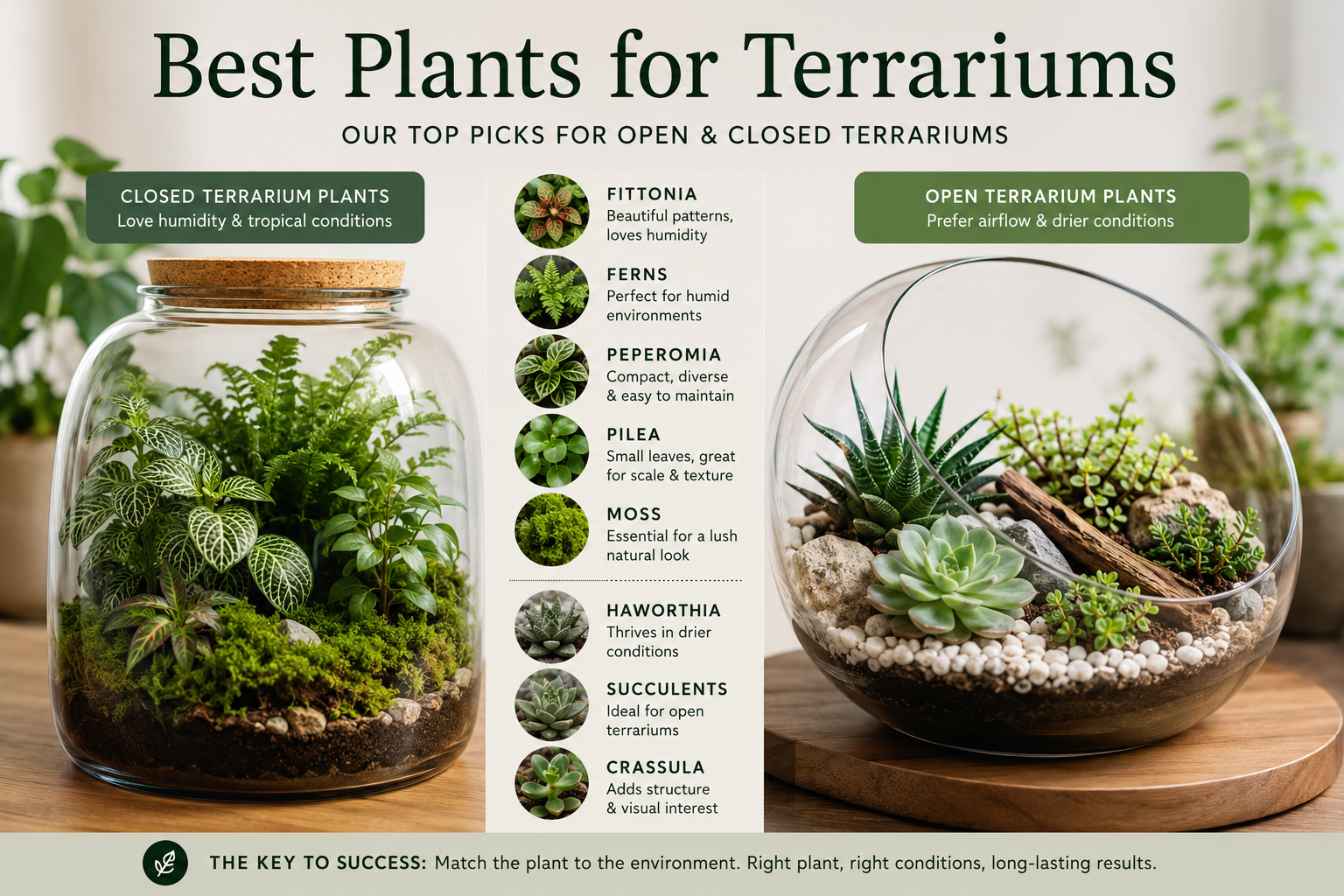
Best Plants for Closed Terrariums
Closed terrariums are essentially miniature ecosystems. Because humidity remains high, they create conditions that resemble the forest floor in tropical and subtropical environments.
That makes moisture-loving tropical plants some of the strongest candidates.
1. Fittonia – One of the Best Plants for Closed Terrariums
Fittonia is perhaps one of the most recognisable closed terrarium plants.
Its compact growth and striking leaf patterns make it particularly useful where visual impact is required without allowing one plant to dominate the entire composition.
Fittonia generally appreciates:
High humidity
Indirect light
Consistent moisture
Warm indoor temperatures
The variety of leaf colours also makes Fittonia useful from a design perspective. Green, white, pink and reddish patterns can be combined with mosses and other foliage plants to create contrast.
For professional planting projects, this makes it possible to create different visual styles while working with plants that prefer broadly similar conditions.
2. Ferns – Classic Plants for Humid Terrariums
Ferns naturally suit the visual character of a terrarium.
Many smaller fern varieties appreciate humid environments and indirect light, making them excellent candidates for a closed glass terrarium.
Their fine foliage also provides a useful contrast against plants with larger or more structured leaves.
The important consideration is size. Not every fern remains small enough for a terrarium. Select compact varieties and consider their mature dimensions rather than their appearance at the time of installation.
This principle applies to virtually every terrarium plant: design for the plant it will become, not just the plant you purchase today.
3. Peperomia – Compact and Versatile Terrarium Plants
Peperomia includes a broad range of species and cultivars with very different leaf shapes, colours and textures.
Smaller varieties can work extremely well in terrariums.
Their decorative foliage makes them particularly useful when building layered plant combinations. Rather than relying purely on flowers, a terrarium can use variations in foliage to create visual interest throughout the year.
Peperomia can therefore be an attractive option for designers looking for small indoor plants for terrariums with a more architectural appearance.
4. Pilea – Excellent Small Plants for Terrariums
Several compact Pilea varieties are well suited to humid indoor environments.
Their smaller leaves can make them especially valuable when creating scale within a terrarium. A common mistake is filling a relatively small glass container with plants that have disproportionately large foliage.
Smaller-leaved species can make the entire landscape appear larger and more detailed.
Pilea can also combine effectively with Fittonia, moss and compact ferns, provided that all plants in the arrangement have compatible requirements.
5. Moss – The Foundation of the Terrarium Look
Although moss is sometimes treated as decoration, it can be an important part of the visual identity of a closed terrarium.
It creates the dense green surface associated with miniature forest landscapes and can visually connect separate planting areas.
Moss generally benefits from the higher humidity found in closed terrariums, although moisture and airflow still need to be managed carefully.
Too much water does not automatically create a healthier terrarium.
That brings us to one of the most important principles in terrarium design.
High humidity and wet soil are not the same thing.
Even moisture-loving plants can struggle when their roots remain permanently saturated.
Best Plants for Open Terrariums
An open terrarium behaves much more like a conventional indoor planter.
There is greater airflow, humidity is lower and the substrate generally dries faster.
This changes which plants are appropriate.
6. Haworthia – A Strong Choice for Open Terrariums
Haworthia is popular because of its compact growth and distinctive structure.
Unlike tropical closed-terrarium plants, Haworthia generally prefers conditions where excess moisture can escape. That makes an open terrarium considerably more appropriate.
Its architectural shape works particularly well in modern interiors and minimalist arrangements.
Avoid combining Haworthia with plants that require constantly humid soil. Although they may look attractive together initially, their different watering requirements can make long-term maintenance difficult.
7. Small Succulents for Open Terrariums
Succulents are often associated with terrariums, but there is an important qualification:
Most succulents should not be placed in sealed terrariums.
Their ability to store water means they generally prefer drier conditions and good airflow. A permanently humid environment can increase the risk of deterioration.
An open glass container can work much better.
When using succulents as open terrarium plants, provide sufficient light and avoid excessive watering.
8. Crassula – Structured Plants for Dry Terrariums
Compact Crassula varieties can provide height and structure in open arrangements.
Their thicker leaves contrast nicely with stone, gravel and other decorative materials, making them useful for contemporary terrarium designs.
Again, drainage and controlled watering are essential.
The goal is not to recreate the humid ecosystem of a closed terrarium but to use the glass container as a design element around plants suited to relatively dry conditions.
Best Low-Light Plants for Terrariums
One of the most common questions around indoor planting is whether terrariums can survive in low light.
The answer depends on what “low light” means.
No living plant can survive indefinitely without sufficient light. However, some low-light terrarium plants tolerate indirect light considerably better than sun-loving species.
Fittonia, certain ferns, Pilea and some Peperomia varieties can be good candidates for areas without strong direct sunlight.
This can make them useful for professional interior environments such as offices, hospitality spaces and reception areas.
Koberg also supplies a broad selection of interior plants for professional projects, which can be viewed here:
https://koberg.nl/en/assortment/plants/interior-plants
For larger interior landscaping projects, it is worth looking beyond the individual plant and considering the complete environment: natural light, artificial lighting, temperature, maintenance frequency and positioning all influence long-term plant performance.
Choosing Terrarium Plants by Size, Light and Humidity
Selecting the best terrarium plants becomes much easier when you evaluate three variables:
Size, light and humidity.
Start with size.
Terrarium plants need enough space to develop. A plant that already touches the glass when installed is unlikely to become easier to maintain as it grows.
Next comes light.
Placing a terrarium in strong direct sunlight can cause temperatures inside the glass to rise considerably. Bright, indirect light is therefore often more suitable for tropical closed terrariums.
Finally, consider humidity.
This is where mixing plants simply because they look good together can cause problems.
A succulent and a moisture-loving fern may create an attractive combination on day one, but their environmental requirements are fundamentally different.
Professional plant selection should therefore focus on compatibility first and aesthetics second.
Once compatible species have been identified, the design can be developed around them.
How to Combine Plants in a Terrarium
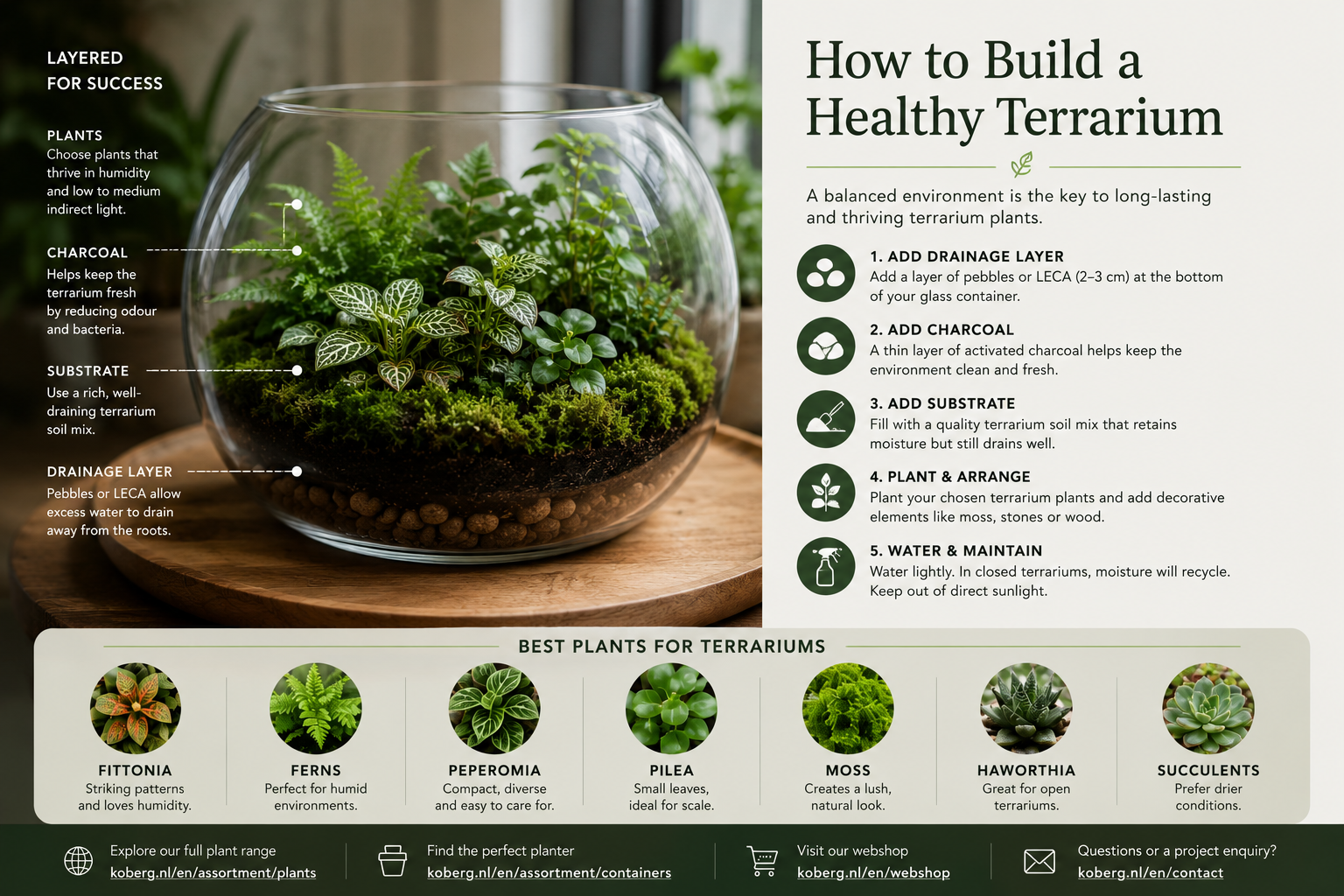
A strong terrarium composition often contains plants performing different visual functions.
You might use one slightly taller plant to create height, compact foliage plants through the middle, and moss or low-growing plants closer to the substrate.
Think in layers rather than individual plants.
Colour also matters.
Different shades of green can already create considerable depth, while plants such as Fittonia can introduce white, pink or red details.
Leaf shape is another important design tool. Combining fine fern foliage with broader Peperomia leaves, for example, creates more contrast than using several plants with almost identical growth habits.
The same principles are frequently used in larger professional indoor planting schemes.
Containers are equally important. Shape, colour, material and proportions can completely change the appearance of a plant arrangement.
Koberg's selection of indoor and outdoor pots can be explored here:
https://koberg.nl/en/assortment/containers/indoor-and-outdoor-pots
This ability to combine plants and planters is particularly relevant for interior landscapers who want to build complete concepts rather than source individual products from multiple suppliers.
Common Mistakes When Choosing Terrarium Plants
One of the biggest mistakes is choosing plants purely based on appearance.
A beautiful combination is not necessarily a sustainable combination.
Putting succulents into a permanently humid closed terrarium is a classic example. Another is mixing plants with completely different light or moisture requirements.
Overplanting is another common problem.
A freshly planted terrarium can look slightly empty, which encourages people to add more plants. But those plants still need room to grow.
A successful terrarium should be allowed to develop.
Watering is another area where less can sometimes be more. Because closed terrariums recycle moisture, they usually require a very different watering approach from normal houseplants.
Understanding the environment is therefore more important than following a fixed watering schedule.
Terrarium Plants for Offices and Professional Interiors
Terrariums can be particularly interesting in professional environments because they bring greenery into spaces where traditional planting may not always fit.
They can be incorporated into offices, reception areas, hotels, restaurants and other commercial interiors.
However, professional applications introduce additional considerations.
Maintenance needs to be predictable. Plants need to remain visually attractive. Containers need to suit the wider interior concept. And when multiple locations are involved, consistency becomes increasingly important.
This is where professional sourcing becomes valuable.
Koberg works with an extensive network of growers and suppliers to provide plants and planters for B2B customers. With more than 55 years of experience and a strong focus on the UK market, we understand the requirements of professional plant buyers and interior landscapers.
You can explore the Koberg webshop here:
https://koberg.nl/en/webshop
Or discover our broader assortment here:
https://koberg.nl/en/assortment
From Individual Terrarium Plants to Complete Interior Planting Concepts
Terrariums may be relatively small, but the principles behind them are very similar to larger planting projects.
The right plant needs to be matched to the right environment.
Light, humidity, temperature, maintenance and container selection all influence the final result.
For professional interior landscapers, this becomes even more important when projects include dozens or hundreds of plants.
Working with a supplier that can source across a broad grower network creates more flexibility in plant choice, specifications and project planning.
At Koberg, we have been connecting professional customers with plants and containers since 1969. Today, our focus remains on reliable B2B supply, tailored assortments and long-term partnerships, with weekly deliveries throughout England.
Whether you are sourcing terrarium plants, indoor plants, large specimen plants or planters for commercial interiors, the principle remains the same:
The best planting projects start with the right combination of plant, environment and container.
Explore our professional plant assortment:
https://koberg.nl/en/assortment/plants
Or contact Koberg to discuss the requirements for your next project:
https://koberg.nl/en/contact
Frequently Asked Questions About Terrarium Plants
What are the best plants for a closed terrarium?
Some of the best plants for closed terrariums include Fittonia, compact ferns, Pilea, Peperomia and moss. These plants generally appreciate the higher humidity found inside closed terrariums. Always check the requirements and mature size of the specific species or cultivar.
What are the best plants for an open terrarium?
Haworthia, small succulents and compact Crassula varieties can be suitable for open terrariums because they generally prefer better airflow and drier conditions than tropical terrarium plants.
Can you put succulents in a closed terrarium?
Generally, a closed terrarium is not the ideal environment for most succulents. The high humidity and limited airflow can create conditions that are too wet. Succulents are usually better suited to open terrariums with appropriate drainage and sufficient light.
Which terrarium plants are best for low light?
Fittonia, some ferns, Pilea and certain Peperomia varieties can tolerate relatively low or indirect light. However, low light does not mean no light. Every living plant still needs sufficient light for healthy growth.
How many plants should you put in a terrarium?
There is no fixed number. It depends on the size of the terrarium and the mature size of the plants. Avoid filling every available space immediately. Leaving room for growth usually produces a healthier and more natural-looking terrarium over time.
Do terrarium plants need direct sunlight?
Many tropical terrarium plants perform better in bright, indirect light than in strong direct sunlight. Direct sun through glass can significantly increase the temperature inside a terrarium.
What is the difference between open and closed terrarium plants?
Closed terrarium plants generally need to tolerate high humidity and consistent moisture, while open terrarium plants are exposed to greater airflow and faster evaporation. This makes open terrariums more appropriate for plants that prefer relatively dry conditions.
What are the easiest terrarium plants for beginners?
Fittonia, selected Peperomia and Pilea varieties can be good starting points for humid terrariums when their environmental requirements are met. For open arrangements, compact succulents can be relatively straightforward when they receive enough light and are not overwatered.
Where can professional interior landscapers buy terrarium and indoor plants?
Professional buyers should look for suppliers that can provide consistent quality, a broad plant assortment and reliable logistics. Koberg supplies plants and planters to professional B2B customers and has extensive experience supplying the UK market.
Explore our interior plant range here:
https://koberg.nl/en/assortment/plants/interior-plants
Or visit:
https://koberg.nl/en