Where Should You Place a Terrarium? Best Locations, Light Conditions and Placement Tips
You have chosen the terrarium. You have selected the plants. Everything looks perfect.
Now comes the surprisingly important question:
Where should you actually put it?
A terrarium may look like a small decorative object, but inside the glass is a living environment. Move it from a bright shelf to a dark corner, place it next to a radiator or leave it in direct afternoon sunlight, and the conditions inside can change considerably.
The best place for a terrarium therefore isn't simply where it looks best. Light, temperature, airflow, humidity and even the type of glass all influence how well the plants perform.
This becomes particularly important in offices, hotels, restaurants and other professional interiors, where a terrarium needs to remain attractive without demanding constant attention.
In this fourth part of our terrarium series, we look at where to place a terrarium, which locations to avoid and how placement differs between open and closed terrariums.
If you're new to the series, you can start with our guide to open vs closed terrariums:
https://koberg.nl/en/blog/open-vs-closed-terrariums-which-solution-performs-better-in-professional-environments-10
What Is the Best Place for a Terrarium?
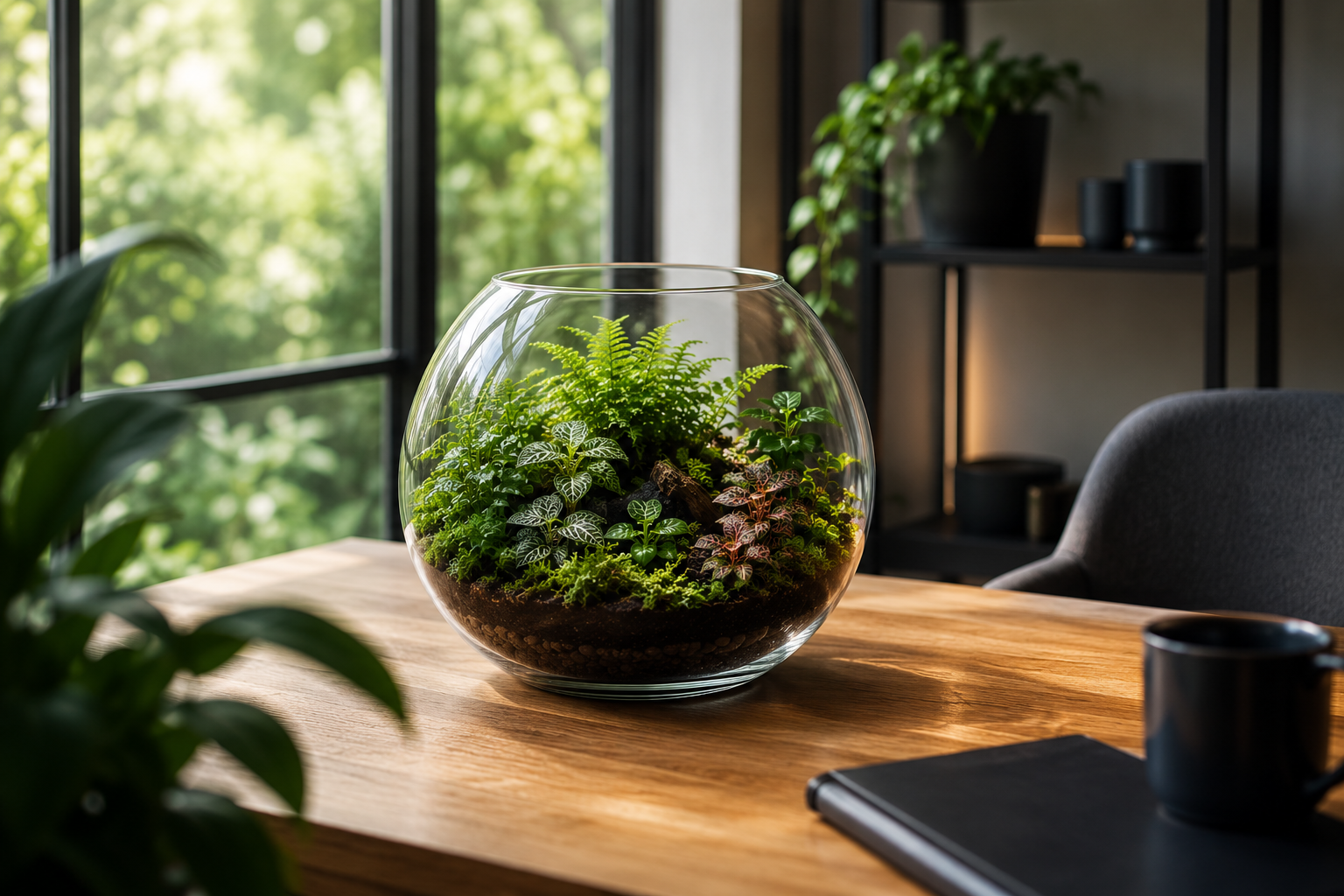
For most terrariums, the ideal location is somewhere with:
- Plenty of bright, indirect light
- A relatively stable indoor temperature
- No strong heat source nearby
- No continuous cold draught
- Enough space around the terrarium
- Conditions appropriate for the plants inside
- The phrase bright, indirect light is particularly important.
Terrariums containing tropical plants such as Fittonia, ferns, Peperomia and Pilea often appreciate good light but don't necessarily need — or want — intense direct sunlight.
And because terrariums are enclosed or partially enclosed by glass, direct sunlight can create an additional problem: heat.
Think of it as a miniature greenhouse.
That beautiful sunny windowsill may therefore be one of the most obvious places to display a terrarium, but it isn't automatically the best one.
Should a Terrarium Be in Direct or Indirect Sunlight?
One of the most common questions about terrarium placement is whether a terrarium needs direct sunlight.
For many tropical terrariums, bright indirect light is the safer choice.
Glass allows sunlight to enter while restricting how quickly heat escapes. Particularly in a closed terrarium, strong direct sunlight can cause the internal temperature to rise.
This means a terrarium shouldn't automatically be placed directly against the sunniest window in the building.
Instead, consider locations where plenty of daylight reaches the plants without intense sunlight continuously hitting the glass.
The exact amount of light required will always depend on the plants you have chosen.
That's why plant selection and terrarium placement should never be considered separately.
In Part 3 of our terrarium series, we looked specifically at the best plants for open and closed terrariums and their different requirements.
https://koberg.nl/en/blog/best-plants-for-terrariums-a-professional-guide-to-open-and-closed-terrarium-plants
Can You Put a Terrarium Near a Window?
Absolutely.
In fact, a location near a window can provide excellent natural light.
The important word here is near, rather than necessarily on the windowsill.
A position slightly further into the room can provide sufficient daylight while reducing exposure to intense direct sunlight.
Window orientation also matters.
A window receiving hours of strong afternoon sun creates very different conditions from one receiving softer indirect daylight.
Seasonality is another factor that's easy to overlook.
A location that receives little direct sunlight during winter may suddenly receive considerably more as the angle and duration of sunlight change throughout the year.
So don't just evaluate a terrarium location once.
Observe it.
If the glass becomes extremely warm, condensation changes dramatically or plants start showing signs of stress, the location may need reconsidering.
Where Should You Place a Closed Terrarium?
A closed terrarium creates its own humid microclimate.
Water evaporates from the substrate and plants, condenses against the glass and eventually returns to the growing medium.
It's one of the things that makes closed terrariums so fascinating.
But it also means environmental stability becomes particularly important.
A good location for a closed terrarium usually offers:
Bright indirect light
Enough light to support plant growth without exposing the container to prolonged intense sunlight.
Stable temperatures
Avoid locations where temperatures fluctuate dramatically throughout the day.
Distance from radiators and heaters
A radiator can rapidly change the temperature around and inside the terrarium.
Protection from strong air-conditioning
Although the container is closed, constantly changing external temperatures can still influence its internal environment.
Closed terrariums are particularly suitable for plants that enjoy humid conditions.
If you're still deciding whether an open or closed design is right for your project, our earlier comparison explains the differences in more detail:
https://koberg.nl/en/blog/open-vs-closed-terrariums-which-solution-performs-better-in-professional-environments-10
Where Should You Place an Open Terrarium?
An open terrarium behaves differently.
Because the top remains open, there is considerably more air exchange with the surrounding environment. Moisture evaporates faster and humidity levels tend to be lower.
This makes open terrariums more appropriate for plants such as certain succulents, Haworthia and other species that prefer drier conditions.
Placement still matters.
An open terrarium needs adequate light, but you should also consider:
- Airflow
- Water evaporation
- Temperature
- Proximity to heating
- The specific requirements of the plants
Because an open terrarium loses moisture more quickly, positioning it directly beside a radiator or strong air-conditioning outlet can make conditions unnecessarily difficult to control.
The objective isn't to find the warmest or brightest spot.
It's to find the most stable environment for the plants you've chosen.
Best Place for a Terrarium in an Office
Terrariums can work particularly well in offices.
They provide a concentrated piece of greenery without requiring the floor space of a large planter.
A terrarium could work on:
- Reception desks
- Meeting-room furniture
- Shelving
- Side tables
- Communal areas
- Large desks or work surfaces
- Display units
But professional environments introduce an additional consideration:
The prettiest location isn't always the most practical location.
Imagine a terrarium positioned in the middle of a reception area because it looks fantastic there.
If that position receives almost no natural light, sits directly underneath an air-conditioning outlet and is next to an entrance door that's constantly opening during winter, the plants may disagree with the interior designer.
For professional projects, consider the environment first and the final decorative position second.
Koberg supplies a broad range of interior plants for professional interior landscaping projects:
https://koberg.nl/en/assortment/plants/interior-plants
Terrariums in Hotels, Restaurants and Hospitality Spaces
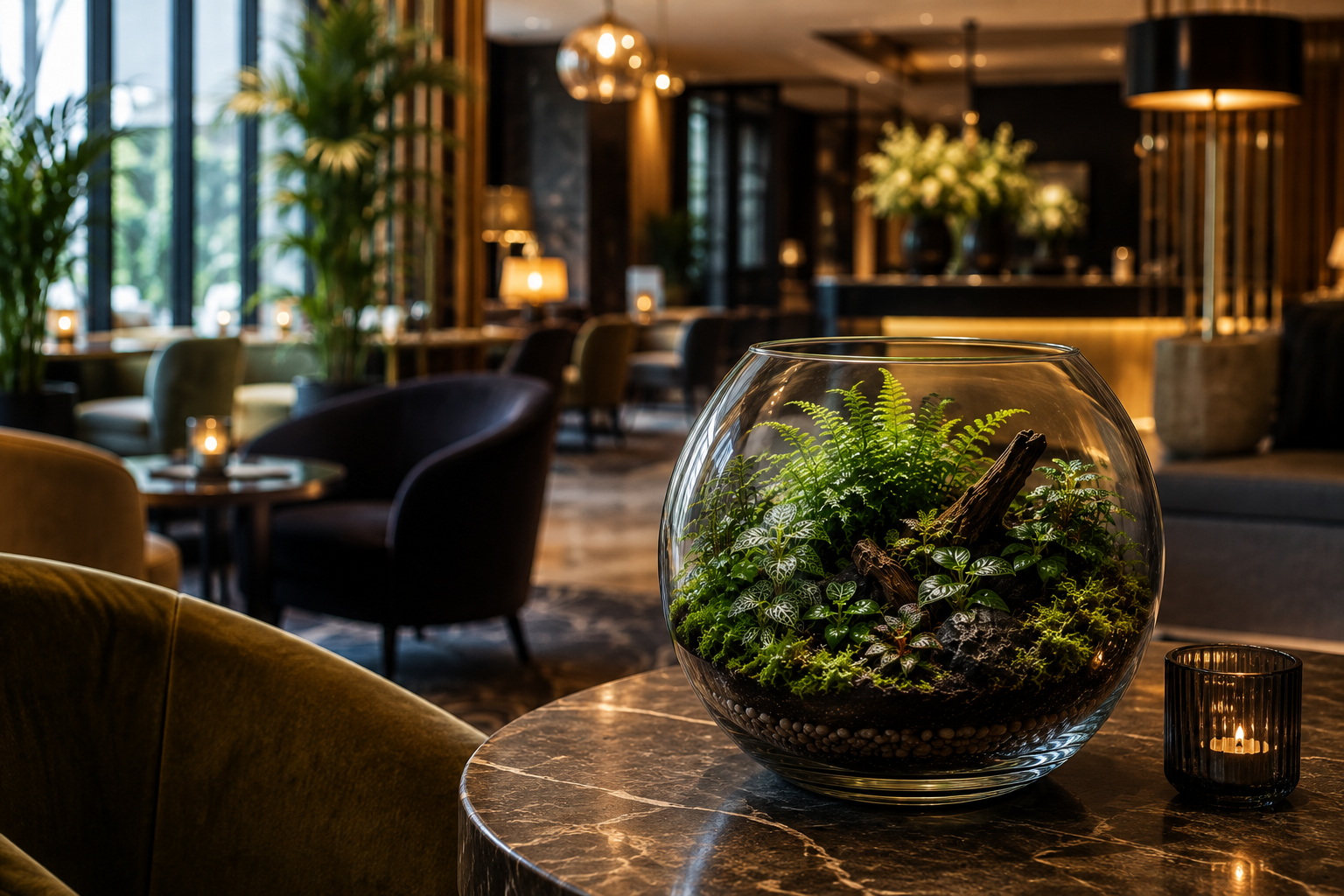
Hospitality environments offer plenty of interesting opportunities for terrariums.
A well-designed terrarium can become a small focal point in a:
Hotel lobby
Large terrariums can create a distinctive natural feature around reception or lounge spaces.
Restaurant
Terrariums can complement natural interior concepts without requiring large planting areas.
Bar or lounge
Subtle lighting combined with glass and greenery can create a particularly atmospheric result.
Meeting or event space
Smaller terrariums can provide decorative greenery without dominating tables or surfaces.
However, these environments can also present challenges.
Artificial lighting, heating, air conditioning, frequent door movement and changing temperatures can all affect plants.
The question should therefore never simply be:
"Where would this terrarium look good?"
Instead ask:
"Where will this terrarium look good AND receive the conditions it needs?"
That small change in thinking can make a major difference to long-term performance.
Can You Put a Terrarium in a Dark Room?
This needs a little nuance.
Some terrarium plants tolerate lower light conditions better than others, but low light does not mean no light.
Plants still need light for photosynthesis.
A dark room, hallway or corner with almost no usable natural light may therefore require appropriate artificial grow lighting if living plants are expected to remain healthy.
Plant selection becomes particularly important here.
Certain ferns, Fittonia, Peperomia and other tropical foliage plants may tolerate lower light conditions better than sun-loving species.
But don't choose a plant purely because it's described as a "low-light plant."
Low-light tolerance isn't the same as preferring darkness.
If you're working on a larger professional interior planting project, you can explore Koberg's plant assortment here:
https://koberg.nl/en/assortment/plants
How Far Should a Terrarium Be From a Window?
Unfortunately, there is no magic number.
Saying that every terrarium should be exactly one, two or three metres from a window ignores too many variables.
The amount of usable light depends on:
- Window size
- Window orientation
- Surrounding buildings
- Trees and external shading
- Season
- Interior layout
- Glass treatment
- Plant species
- Local climate
A large unobstructed window can illuminate a room very differently from a small window surrounded by buildings.
Instead of focusing purely on distance, look at the actual light conditions at the terrarium's position.
This is particularly relevant for professional interior landscapers, where multiple planting locations within the same building can have completely different conditions.
Places You Should Avoid When Positioning a Terrarium
Sometimes it's easier to understand good terrarium placement by looking at the locations that commonly cause problems.
1. Directly Above or Next to a Radiator
Heating can create rapid temperature changes and increase evaporation.
This is particularly problematic when the terrarium contains humidity-loving plants.
2. In Strong Direct Afternoon Sun
A glass container receiving intense sunlight can heat up quickly.
For many tropical closed terrariums, a bright location with indirect sunlight is more appropriate.
3. Directly Under Air Conditioning
Strong, continuous airflow can influence temperature and moisture levels, particularly in open terrariums.
4. Completely Dark Corners
A terrarium may look fantastic on a dark bookshelf, but the plants still need sufficient light.
5. High-Traffic Locations
Terrariums are made from glass.
That sounds obvious, but it matters.
Avoid narrow walkways, unstable surfaces or places where bags, chairs or people frequently pass close to the container.
Especially in commercial interiors, practical placement is just as important as botanical placement.
Does a Terrarium Need to Be Rotated?
Potentially.
If most of the light comes from one direction, plants may gradually grow towards the light source.
Occasionally rotating the terrarium can help encourage more balanced growth and also gives you an opportunity to inspect the plants from different angles.
However, constantly moving a terrarium between completely different environments isn't ideal either.
Consistency is valuable.
Rather than moving it every few days, choose a strong permanent location and make smaller adjustments when necessary.
How Temperature Affects Terrarium Placement
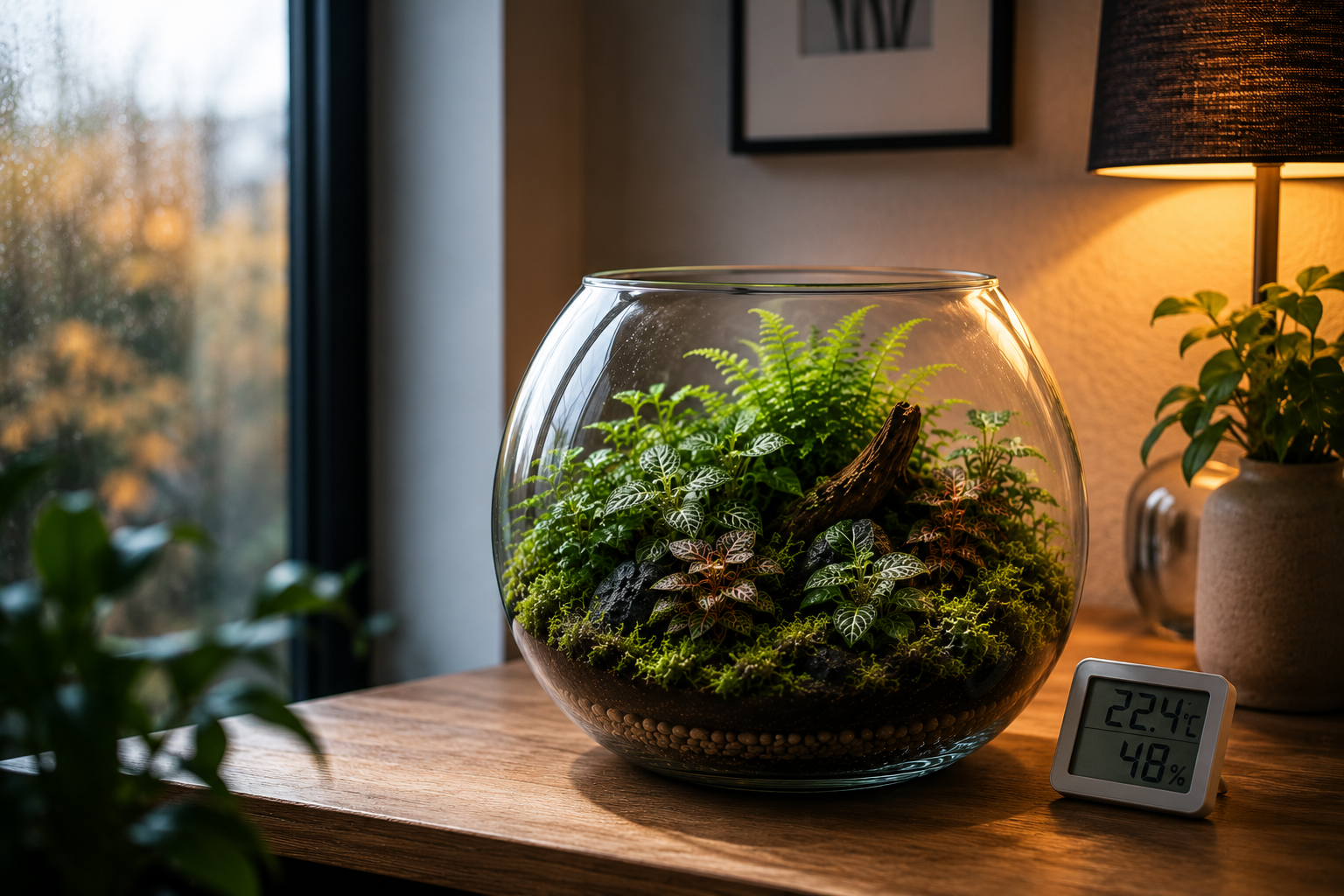
Light gets most of the attention, but temperature is just as important when choosing where to place a terrarium.
Many popular tropical terrarium plants prefer relatively stable indoor conditions.
That makes locations with large temperature fluctuations less attractive.
Examples include:
- Beside frequently opened exterior doors
- Directly next to heaters
- In conservatories that become extremely warm
- Against cold windows during winter
- Close to powerful air-conditioning systems
This becomes even more important in commercial interiors, where heating and cooling systems may operate on different schedules throughout the week.
A comfortable temperature on Monday afternoon doesn't necessarily tell you what happens in the same location on Sunday morning.
For professional planting projects, understanding how the building actually operates can therefore be just as valuable as understanding the plants.
Terrarium Placement and Interior Design
Of course, we're not suggesting that terrariums should only be placed according to a light meter.
They're decorative objects too.
The best result combines plant health with strong interior design.
Terrariums work particularly well where their details can actually be appreciated.
Rather than hiding one on top of a tall cabinet, consider positioning it closer to eye level.
Glass also interacts beautifully with natural and artificial light, while the plants, moss, stone and substrate create texture.
The container itself becomes part of the design.
Shape, proportions and material all influence how the planting is perceived.
For larger interior planting projects, this same principle applies to conventional plant containers. You can explore Koberg's indoor and outdoor planter range here:
https://koberg.nl/en/assortment/containers/indoor-and-outdoor-pots
How to Know if Your Terrarium Is in the Wrong Place
Plants are surprisingly good at telling you when something isn't right.
Look for changes such as:
Plants stretching towards the light
This may indicate insufficient light.
Bleached or scorched foliage
Strong sunlight may be contributing to plant stress.
Very rapid drying
The location may be too warm or exposed to excessive airflow.
Persistent excessive condensation
The balance between moisture, temperature and ventilation may need attention.
Plants deteriorating despite correct watering
Light or temperature could be the underlying issue.
Don't immediately assume every problem is caused by watering.
Location is often overlooked because it's less obvious.
Before replacing plants, take a critical look at their environment.
The Best Terrarium Location Starts With the Plants
There isn't one universally perfect place for every terrarium.
And that's really the most important takeaway.
A closed tropical terrarium filled with Fittonia and ferns requires different conditions from an open terrarium containing Haworthia and succulents.
Start with three questions:
What plants are inside?
How much light do they need?
What environment does this particular location provide throughout the day and year?
Once those questions are answered, choosing the right position becomes much easier.
At Koberg, we work with professional growers and suppliers to source plants for a wide variety of interior and exterior applications. From small-scale greenery to complete professional planting projects, the principle remains the same:
Right plant. Right environment. Right place.
Explore our plant assortment:
https://koberg.nl/en/assortment/plants
Or browse the Koberg webshop:
https://koberg.nl/en/webshop
Frequently Asked Questions About Terrarium Placement
Where is the best place to put a terrarium?
For many terrariums, the best location provides bright indirect light, stable temperatures and protection from strong heat sources or draughts. The exact location should always be matched to the plants inside the terrarium.
Should a terrarium be in direct sunlight?
Many tropical terrariums are better suited to bright indirect light than prolonged direct sunlight. Glass can trap heat, causing the temperature inside the terrarium to rise.
Can I put a terrarium on a windowsill?
You can, but it depends on how much direct sunlight the windowsill receives. A bright windowsill exposed to hours of intense sunlight may become too warm, particularly for a closed terrarium.
Can a terrarium survive in a dark room?
Living terrarium plants still require sufficient light. Some species tolerate relatively low-light conditions, but no-light environments are unsuitable for long-term healthy plant growth unless appropriate artificial plant lighting is provided.
Can I put a terrarium in an office?
Yes. Terrariums can work well on reception desks, shelving, meeting-room furniture and other office surfaces. Consider natural light, heating, air conditioning and the stability of the location before choosing the final position.
Can a terrarium be placed near a radiator?
It's generally better to avoid placing a terrarium directly beside or above a radiator. Heat can increase evaporation and create temperature fluctuations that may negatively affect the plants.
How far should a terrarium be from a window?
There is no universal distance. Window orientation, size, external shading, season and plant requirements all influence how far a terrarium can be positioned from natural light.
Do closed terrariums need sunlight?
Closed terrarium plants need light, but that doesn't necessarily mean direct sunlight. Many tropical species perform well with sufficient bright, indirect light.
What is the best place for a terrarium in an office or commercial interior?
Choose somewhere visible and attractive but also botanically suitable. Reception areas, meeting rooms and communal spaces can work well when there is adequate light and a stable temperature. Avoid positioning terrariums directly under air-conditioning vents or beside heating systems.