Why Some Plants Thrive Indoors — and Others Never Will
We all know the situation. A beautiful plant arrives looking full, green and healthy. A few weeks later, it starts dropping leaves, develops brown edges or simply looks… unhappy.
The first reaction is often predictable: too much water? Too little water? Does it need fertiliser?
Maybe.
But quite often, the real problem started much earlier. The plant simply wasn't the right plant for that particular environment.
At Koberg, we have been working with plants since 1969. Over the years, we've seen thousands of varieties pass through nurseries, projects, offices, hotels, restaurants and other commercial interiors. And if there is one thing we've learned, it is this:
Choosing a plant because it looks good is easy. Choosing a plant that will still look good months later requires knowledge.
So, what actually makes a plant suitable for an indoor environment?
Let's take a closer look.
A plant doesn't know it's decoration
This sounds obvious, but it's worth remembering.
We look at a plant and see an interior product. Something that fills an empty corner, softens an office environment or creates atmosphere in a hotel lobby.
The plant sees things differently.
As far as the plant is concerned, it is trying to survive.
It needs light. It reacts to temperature. It loses water through its leaves. Its roots need oxygen. It responds to humidity and notices changes in its environment.
And unfortunately, modern buildings are designed primarily for people, not plants.
Air conditioning, heating, tinted windows, automatic blinds and artificial lighting might make a building comfortable and energy-efficient, but they can create challenging conditions for greenery.
That's why successful interior planting starts with the environment rather than the plant catalogue.
Light is usually the biggest misunderstanding
"This room has plenty of light."
We hear variations of this all the time.
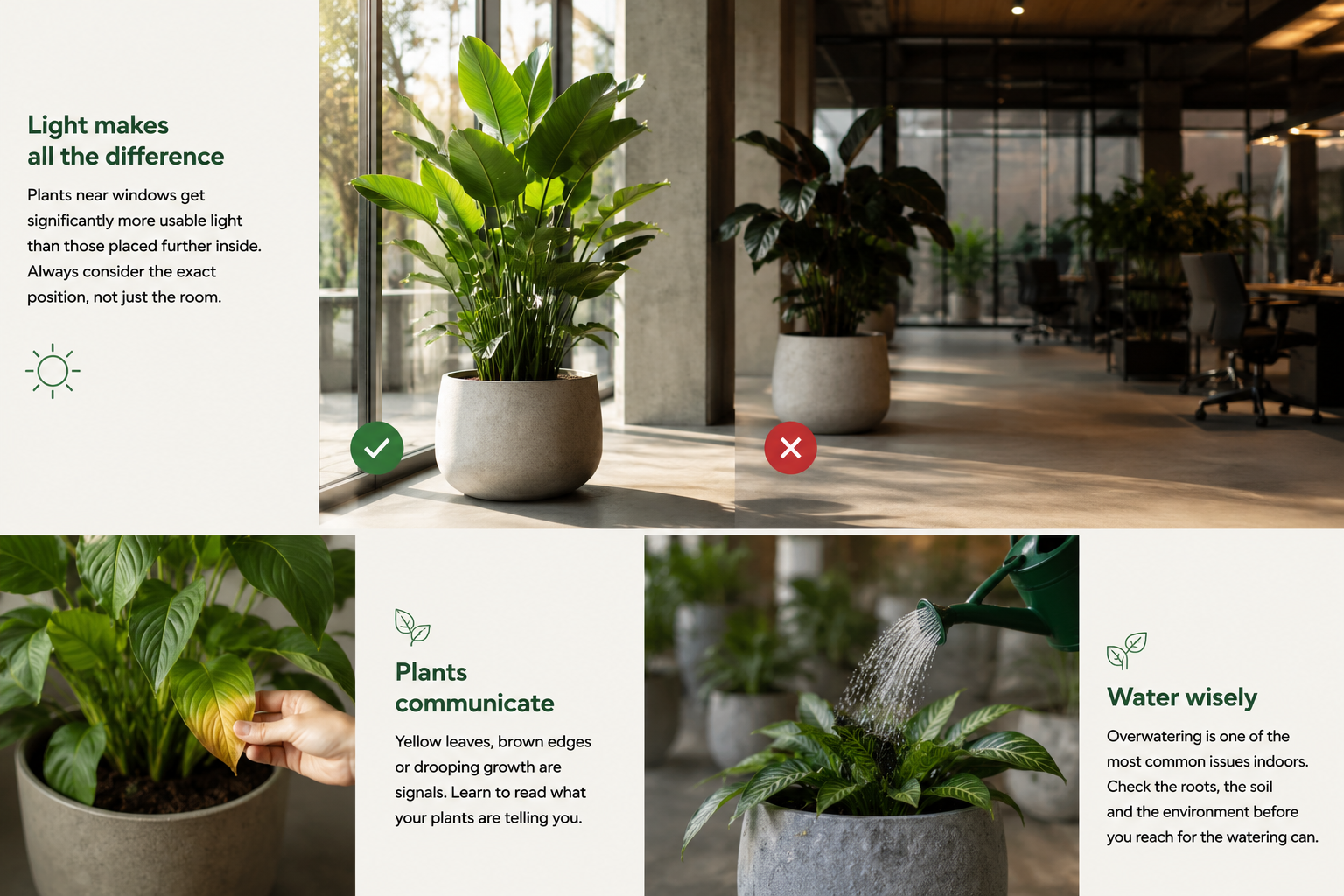
But what feels bright to a person isn't necessarily bright to a plant.
Our eyes are extremely good at adapting. Walk into a relatively dark office and after a few minutes it can feel perfectly normal. A plant doesn't have that luxury.
Distance from a window makes a surprisingly large difference. A plant positioned several metres inside a building can receive dramatically less usable light than one placed directly beside the glass.
Then there is the direction of the window, the season, surrounding buildings, tinted glass and blinds.
This explains why two identical plants in the same building can perform completely differently.
One might thrive near a window.
The other, ten metres further into the room, slowly deteriorates.
Same plant. Same watering schedule. Completely different environment.
When choosing plants for interiors, we therefore like to think in terms of locations first and varieties second.
Where exactly will the plant stand?
How much natural light reaches that position?
Will the conditions remain similar throughout the year?
Once you know that, choosing the right plant becomes much easier.
The "indestructible plant" doesn't exist
Some plants certainly deserve their reputation for being tough.
Sansevieria, Zamioculcas, Aglaonema and several Dracaena varieties, for example, are popular in commercial interiors for good reason. They generally tolerate indoor conditions better than many more demanding species.
But "tolerates" is not the same as "doesn't need".
Even a very strong plant has limits.
Put it in an extremely dark corner for long enough and eventually the quality will decline.
This is particularly important in commercial projects.
A plant doesn't necessarily die immediately when conditions aren't suitable. Instead, it might slowly lose quality.
Leaves become smaller.
Growth slows.
Colour becomes less intense.
Lower leaves disappear.
And six months later everyone wonders why the installation no longer looks anything like it did on day one.
Good interior planting isn't about finding plants that are impossible to kill.
It's about matching the right plant with the right conditions.
More water isn't always more care
Here's another common misconception.
A plant looks unhappy, so someone gives it water.
A few days later it still looks unhappy.
More water.
And again.
Before long, the plant isn't suffering from neglect. It's drowning in attention.
Overwatering remains one of the most common problems with indoor plants.
Roots need both moisture and oxygen. When the growing medium remains saturated for too long, the amount of oxygen around the roots decreases. Root health deteriorates and ironically, the plant can begin showing symptoms that look like dehydration.
This is where things become confusing.
Yellow leaves? Could be too much water.
Drooping leaves? Could be too little water.
Brown edges? Could have several causes.
There isn't always one universal answer.
That's also why experienced plant maintenance is so valuable. Instead of reacting to one symptom, you look at the complete picture: the species, root system, substrate, location, temperature, season and watering history.
Plants are surprisingly good at telling you something is wrong.
You just have to learn their language.
Big leaves aren't automatically better
Large tropical plants are fantastic.
A beautiful Strelitzia, Ficus or Alocasia can completely transform a room. One impressive specimen can have more visual impact than ten smaller plants.
But there is a trade-off.
Generally speaking, the more specific the natural habitat of a plant is, the more carefully you need to consider whether an interior can provide suitable conditions.
This doesn't mean you should avoid statement plants.
Quite the opposite.
It means you should use them strategically.
A dramatic plant in the right position can become the centrepiece of an interior. Put the same plant somewhere unsuitable simply because the corner needed "something green", and it can quickly become an expensive maintenance problem.
This is one of the reasons professional interior landscaping is about much more than selecting attractive products.
You're designing a living installation.
Don't forget what happens above the plant
We naturally focus on pots, floors and windows.
But look up.
Air-conditioning vents can be surprisingly problematic.
A plant might have excellent natural light and receive exactly the right amount of water, yet still develop dry or damaged leaves because cold or warm air is constantly blowing across it.
The same applies to entrances.
Plants positioned next to doors can experience repeated temperature fluctuations, particularly during winter.
And then there are radiators.
A beautiful plant positioned directly beside a radiator might look perfect in the design visualisation. In reality, it could spend the winter fighting warm, dry air.
Sometimes moving a plant one metre can make more difference than changing the entire maintenance routine.
The pot matters too
We love plants, but we also spend a lot of time thinking about pots and planters.
And not just because they look good.
The relationship between plant and container is important.
A planter needs to be proportionate to the plant, suitable for the root system and practical for maintenance. Depending on the installation, liners, drainage solutions and planting systems can make a significant difference.
Then there is visual proportion.
A small pot under a huge plant can make the whole installation look unstable. An oversized planter with a relatively small plant can have the opposite effect.
The best combinations feel natural.
You don't immediately think: "That's a nice pot."
Or: "That's a nice plant."
You look at the complete combination.
That's when you know it works.
Sometimes artificial is actually the professional choice
Yes, a plant supplier just said that.
There are locations where a living plant simply isn't the best solution.
Very dark areas, difficult-to-access spaces, certain hospitality environments or locations where consistent appearance is essential can all make artificial planting a sensible alternative.
Modern artificial plants have improved enormously. High-quality artificial greenery can be extremely convincing, particularly when it is incorporated properly into an interior design.
The mistake is pretending every location needs a living plant.
It doesn't.
Our preference is always to look at what the project actually requires.
Sometimes that's a beautiful living specimen.
Sometimes it's artificial greenery.
And increasingly, projects use both.
The objective shouldn't be to put as many living plants into a building as possible.
The objective should be to create the best green environment possible.
Plants change — and that's part of the beauty
One thing we sometimes forget when looking at perfectly styled project photography is that plants aren't furniture.
They grow.
They turn towards light.
Old leaves disappear and new ones emerge.
Some varieties become wider, others taller.
A plant installation that looks perfectly balanced on day one might look completely different two years later.
And that's not necessarily a problem.
In fact, that's one of the reasons we love working with plants.
An interior containing living greenery is never completely finished.
It evolves.
Good planning simply makes sure it evolves in the right direction.
So, how do professionals choose?
There is no magic list of ten plants that work everywhere.
We wish there was.
Instead, we normally consider a combination of factors:
Light — How much usable natural or artificial light is available?
Temperature — Is the environment relatively stable?
Humidity — Particularly important for certain tropical varieties.
Maintenance — How often can someone realistically inspect and maintain the plants?
Position — Near windows, entrances, heating or air-conditioning?
Scale — Does the plant fit the room today, and will it still fit when it grows?
Purpose — Is the planting meant to create privacy, make an architectural statement, divide a space or simply introduce greenery?
Container — What planter size, style and planting solution works best?
Only after answering those questions does the plant selection really begin.
And perhaps that's the biggest difference between buying plants and creating an interior planting concept.
What 55+ years around plants teaches you
Koberg started in 1969.
A lot has changed since then.
Plant varieties have changed. Interiors have changed. Logistics have changed. Customer expectations have changed enormously.
The UK market that we have worked with for decades has changed too.
But plants themselves still follow the same basic rules.
They don't care about trends.
They don't care which variety is currently popular on Instagram.
They respond to their environment.
Our role has therefore increasingly become one of connecting knowledge.
We work closely with a large network of professional growers and suppliers and combine their specialist knowledge with what we learn from customers and projects.
One grower might know everything about a particular Ficus.
Another specialises in palms.
Another has spent decades perfecting the cultivation of Dracaena, Schefflera or tropical foliage.
That network is incredibly valuable because nobody can be an expert in every plant.
Good advice often starts with knowing who to ask.
And sometimes the answer is simply: don't use that plant
Perhaps the most valuable advice in our industry isn't always recommending something.
Sometimes it's saying no.
No, we wouldn't put that variety there.
No, that size probably isn't practical.
No, we don't think it will perform well in that location.
And then finding an alternative that gives a similar visual effect but has a much better chance of succeeding.
Because supplying a beautiful plant is relatively easy.
Supplying the right plant is much more interesting.
At Koberg, that's what more than 55 years in the plant industry has taught us.
There are thousands of plants to choose from and almost endless combinations of plants and planters.
But the question we keep coming back to is surprisingly simple:
Will it still look good later?
If the answer is yes, you're probably on the right track.